

A Big Visual Shift: From Plate to “Inverted Pyramid”
If you’ve been around nutritional therapy or naturopathy for any length of time, you’ve probably heard (and said) some version of this for years:
“Eat real food.”
“Eat whole foods.”
“Choose foods you could make from ingredients you recognize.”
It’s not a new concept — but it is becoming more widely accepted, and that’s genuinely a positive shift.
What’s interesting now is that this “real food” message is no longer just coming from holistic health circles. The Dietary Guidelines for Americans (DGA) 2025–2030, which are updated every five years, have been released with a noticeably different tone and visual emphasis than what many people are used to.
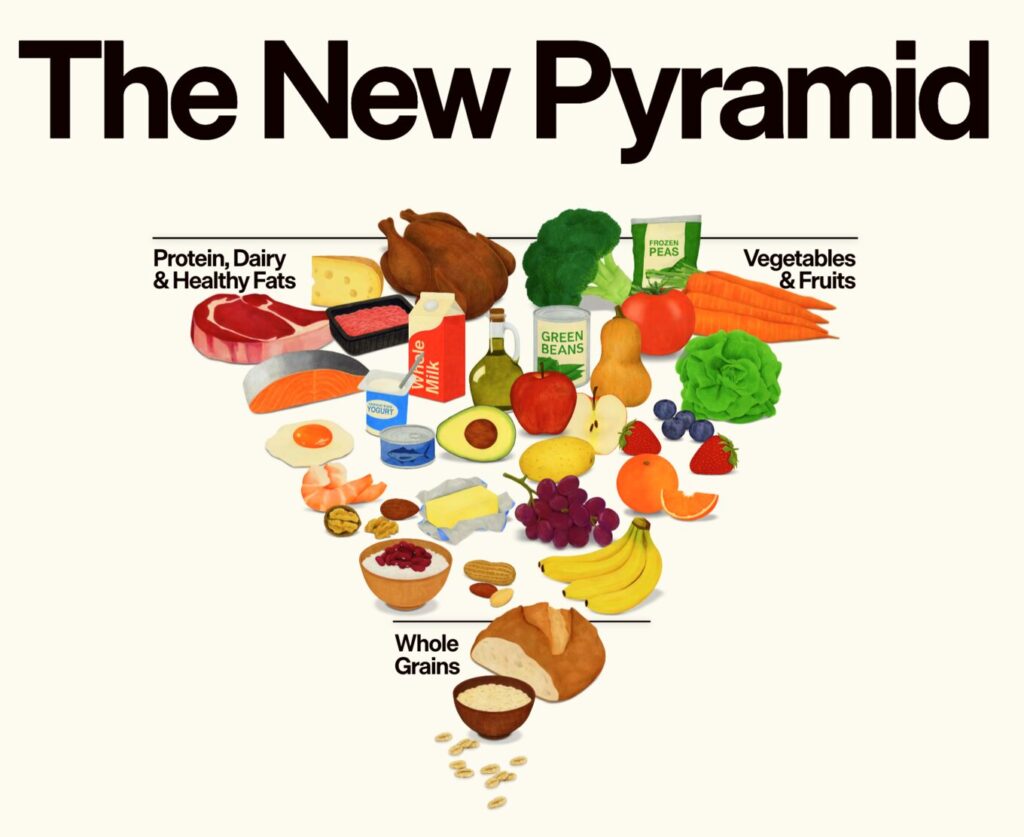
The newer messaging has returned to a pyramid-style model — but flipped (an “inverted” pyramid). In this updated visual, foods like protein, dairy, healthy fats, vegetables, and fruits are emphasized at the top, while grains appear at the base.
Even without reading a single word, that kind of graphic naturally makes people think:
“Maybe I should reduce bread, pasta, and refined carbs…?”
And honestly, that’s not an unreasonable takeaway — because carbohydrates often become the “main character” of meals by default (easy, filling, convenient), which can crowd out fiber-rich vegetables and adequate protein.
What the New Guidelines Emphasize
1) Higher protein targets
Coverage of the new guidelines notes a marked increase in recommended protein intake — commonly described as 1.2–1.6 g/kg/day, which is substantially higher than the older, widely-cited baseline of 0.8 g/kg/day.
Clinical reality check (important):
Higher protein can be helpful — but it’s not automatically better for everyone.
In practice, people can run into “minor” but quality-of-life symptoms if we push protein without considering:
digestive capacity (stomach acid, bile flow, enzyme output)
the type of protein (very fatty meats vs. leaner options)
gut sensitivity or constipation tendency
overall meal balance (fiber, hydration, minerals)
For many people, eggs, chicken, and fish/seafood are often easier to digest than heavier cuts of red meat — and they can be great anchors for consistent protein at meals.
2) “Healthy fats” — including a softening around saturated fat
One of the more controversial headlines: the guidance appears more accepting of traditional fats like butter and animal fats, while still advising limits on saturated fat overall.
From a whole-food perspective, I understand why this resonates with so many people:
A “low cholesterol” label doesn’t automatically mean “healthy,” and highly processed fat substitutes can come with their own downsides (ingredients, additives, oxidation, ultra-processing, etc.).
That said, nuance matters:
Some people feel fantastic when they switch from ultra-processed spreads to real fats in sensible amounts.
Others (especially with certain lipid patterns or cardiovascular risk factors) may need a more individualized approach.
3) Stronger messaging to reduce highly processed foods and added sugars
Multiple summaries of the DGA highlight a renewed focus on minimizing highly processed foods and added sugars, aligning with the broader “real food” direction.
This is one of the areas where most practitioners — conventional and holistic — can probably agree:
If a “food” is mostly refined starch, industrial oils, added sugar, and flavor chemistry, it shouldn’t be the daily foundation.
4) Vegetables and fruit still matter
Even with all the attention on protein and fats, vegetables and fruit remain central in most official healthy eating frameworks.
For day-to-day health outcomes, this is often where results come from fastest:
better bowel regularity
improved micronutrient density
improved satiety signals
better blood sugar stability (especially when paired with protein)
Ready to Make “Real Food” Work for You?
If you’d like support tailoring your meals (protein targets, digestion-friendly food choices, fat quality, and a realistic plan you can actually stick to), let’s make it simple.
Book your consultation using the booking link/button and we’ll map out a personalized strategy that fits your body and your life.